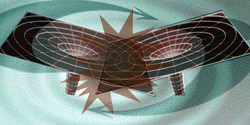
Einstein's theory of general relativity predicts that when masses accelerate, they give off energy in the form of gravitational waves. An analogy of this would be the way accelerating charges produce electromagnetic waves. Gravitational waves are disturbances in the curvature of space-time caused by the motions of matter. These waves propagate through space at the speed of light. If a gravitational wave passed 2 observers in space, the distance between them would seem to stretch or shrink. The magnitude of the stretch or shrink would be proportional to the distance between the observers. Gravitational waves are weak and only stretch or shrink space by very small scales. As such, they are extremely difficult to detect and require very precise and sensitive equipment to help us in our search for black holes.
|
Once sensitive equipment can be built to detect these weak gravitational waves, we could then detect the gravitational waves that are generated when a massive star collapses to form a black hole. In addition, when existing black holes interact with one another or with other objects such as neutron stars through collisions, they produce vibrations that could also be picked up by these detectors. |
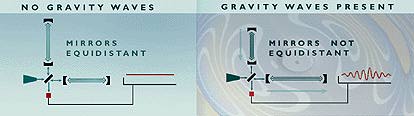
| At present, the Laser Interferometer Gravitational-Wave Observatory (LIGO) is being built. LIGO will be able to detect these gravitational waves by using a laser-interferometer in which the time that it takes for light to travel between two mirrors suspended far apart is measured. The mirrors are arranged so that they form two arms connected like an L. Laser light enters at the end of the arms and is split up by a beam splitter. The light then bounces back and forth in a vacuum between the mirrors and gets sent back to the beam splitter. If the two arms are of equal lengths, there would be no interference between the beams and all the light will be sent back to the laser. Otherwise, some light will travel to where it can be recorded by a photodetector. When gravitational waves cause space-time to stretch or shrink, the distance measured by the light changes and the amount of light that is recorded by the photodetector changes accordingly. The photodetector then produces an electric signal that tells us how the amount of light falling on it varies over time. In this way, gravitational wave signals are transformed into electric signals and we will know if a gravitational wave passes us by. |
|
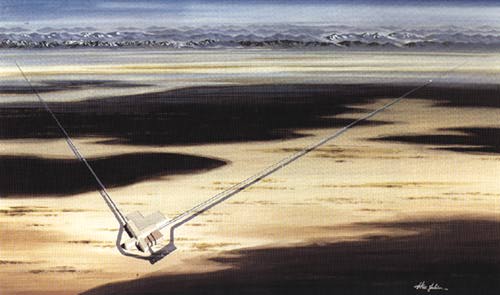 Picture of proposed LIGO.