During most of a star's lifetime, nuclear processes in the core of a
star generate electromagnetic radiation that prevents it from
collapsing under its own gravitational pull. Once the nuclear fuel in
the core is depleted, the radiation pressure that holds the star up decreases,
and very soon, the star begins to collapse.
Depending on its mass, a star becomes either a white dwarf, a neutron
star or a black hole when it dies. Stars with masses less than 3
solar masses collapse to form a white dwarf or a neutron star.
Although nuclear fusion no longer goes on in these stars, white dwarfs
and neutron stars continue to be held up by electron and neutron
degeneracy pressures respectively. Very massive stars, on the other
hand, are unable to support themselves against their own gravitational
pull, and collapse to form black holes.
|
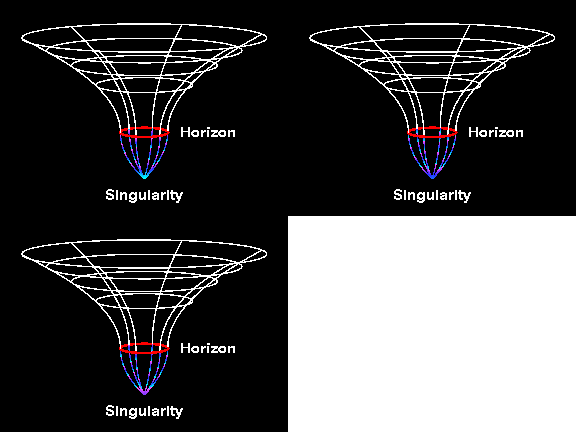
Einstein's theory of general relativity presents gravity as a
manifestation of the curvature of spacetime. In 1916, just after the
theory of general relativity was established, German
physicist Karl Schwarzschild calculated what space surrounding a point
mass would appear like. He found that at small radii surrounding the
object, the solution to the Einstein equation behaved strangely. At
r=0, in particular, there was a singularity where the curvature of
spacetime was infinite. A black hole is the space around the
singularity where gravity becomes so overpowering that nothing,
including light and other forms of electromagnetic radiation escapes
it.
|
|
|
When a massive star begins to burn out, an apparent event horizon
forms. The apparent event horizon separates the light rays that might
have a chance of escaping from those that are doomed to be sucked into
the black hole forever. The light rays in the apparent event horizon,
however, might still get sucked back in if more mass collapses, thus
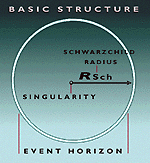
increasing the gravitational pull. The event horizon is a spherical
shell around the singularity of infinite density which defines the
surface of the black hole. The radius of the event horizon is known as
the Schwarzschild radius. Once anything passes through the
Schwarzschild radius, it is doomed for eternity, as it will never be
able to resist the strong gravitational pull of the black hole.
|