 |
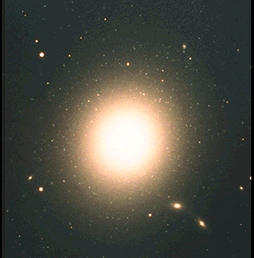
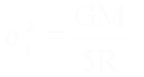
When a galaxy is in dynamical equilibrium, the virial theorem can be used to show that the radial velocity dispersion of the constituent stars inside a radius R is described by the equation to the right where M is the total mass contained inside R. Since, in practice, the dispersion is the observable quantity, the mass inside R can be found instead. When this method is applied to certain galaxies, the resultant mass inside a certain radius is so large that it is likely that a collapsed body, a supermassive black hole, is present at the galactic core. For example, M87 has a core given by the dispersion equation of three billion solar masses in a region smaller than our solar system!! |