In the 1940s, British astronomers Hermann Bondi, Fred Hoyle, and
Raymond Lyttleton investigated the possibility of a star gathering
matter from the surrounding medium due to gravitational attraction.

|
If we consider a star at rest, it will attract matter that is fairly close to it. For a particle to be affected significantly by the gravitational pull of a star, its initial trajectory must lie within the boundary of a cylinder with radius R=4GM/cv. This pull by the star on the particle causes the particle to bend toward it and eventually, the particle falls on the star as it loses its transverse momentum. |
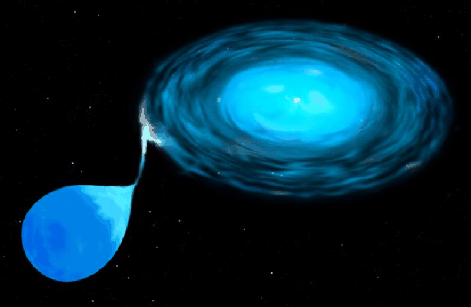
| In a binary system, the denser object (may be a white dwarf, neutron star or black hole) accretes gas from its companion. The gas from the companion star's surface behaves like a fluid. The fluidity of the matter is important, as the pressures and collisions within the fluid causes the matter to lose its transverse momentum, thus enhancing the rate of accretion. The presence of the companion star also acts as a large source of matter and intensifies the rate of accretion since the dense object does not have to pull matter in from the diffuse interstellar medium. In addition, the two stars in the binary do not only revolve around each other, but also rotate about an axis, much like the way the earth rotates about its axis. The path of the accreted matter is affected by this rotation as shown in the diagram. When the matter escapes from the surface of star A, it may either leave the system at L2, come back to star A through L1 or circulate round the dense star B. The matter thus loses its angular momentum and gains energy as it falls toward the dense star, forming a disk around it. |
|
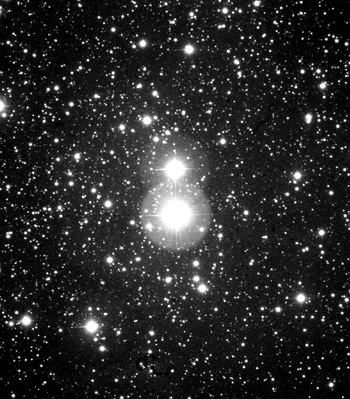
| An example of a possible "star-black hole" binary system is Cygnus X-1. Cygnus X-1 is an X-ray binary system of which the visible component is a B type, supergiant star with an estimated mass of about 20 solar masses. The period of the system which is determined from its optical properties is 5.6 days. The radial velocity of the visible component can be estimated from its Doppler shift. Using methods which we have learnt earlier in the course regarding binary star systems, we can find the mass of the phantom component. The mass of the invisible member has been estimated to be at least 5 solar masses. Hence, speculations have been made that Cygnus X-1 is indeed eclipsing a black hole because this lower limit of 5 solar masses is way higher than the maximum mass of a neutron star of 3 solar masses. |
|