Donald Knuth developed TeX (pronounced "tech", with the “ch” as in the Scottish “loch”) in the 1970s to enable mathematicians, computer scientists, and scientists to produce beautiful documents that include equations. LaTeX is a popular extension to TeX that provides a higher-level user interface, allowing authors to focus more on the content of the document and less on formatting nitty gritty. TeX and LaTeX are freely available and there are implementations to run TeX/LaTeX on essentially all computing platforms. Besides the clean output, an advantage of LaTeX is the seamless way you incorporate mathematics in the text, without leaving your editor. Here are two examples: |

|
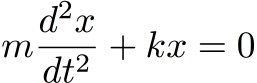
$ m \frac{d^2 x}{dt^2} + kx = 0 $
\newcommand{\pdd}[2]{\frac{\partial^2 #1}{\partial #2^2}
|
|
The first step is to gain access to a system that already has a TeX program installed, or to download and install one yourself.
![]() |
![]() |
|
A nice free implementation of TeX is TeXShop, which produces PDF documents directly from TeX source, and includes a simple editor with built-in templates. For including equations into graphics and presentations, you'll appreciate the LaTeX Equation Editor, which takes a (La)TeX expression and produces a graphic that you can drag and drop into Keynote, OmniGraffle, PowerPoint, or other graphics program in PDF or TIFF format. An alternative to consider is LaTeXiT, which incorporates LinkBack technology to allow you to double-click the embedded equations to re-edit them. |
MikTeX is a popular free implementation of TeX on Windows, that you use in conjunction with a text editor. TeXnicCenter is a feature rich integrated development environment (IDE) for developing LaTeX-documents on Microsoft Windows (Windows 9x/ME, NT/2000/XP) freely available under GPL. Many people like the shareware program WinEdt, which has many powerful and convenient features for linking with MikTeX. | Linux distributions generally have TeX installed. Emacs is perhaps the editor of choice, although I'm sure there are some fans of vi, or its progeny. |
There are many fine resources online for learning LaTeX.
Additionally, the Comprehensive TeX Archive Network (CTAN) provides a treasure trove of up-to-date TeX and LaTeX information and sources.
If you are hunting for a symbol, try the Comprehensive LaTeX Symbol List.
If you would like to use LaTeX to prepare a presentation (as
in, you are looking for a TeX alternative to PowerPoint), I
recommend looking into the beamer package, which is
installed automatically by recent versions of teTeX.
\begin{document} line to a new file, and
save it. Call it something like myfmt.texpdflatex -ini and
press return.&pdflatex
myfmt.tex\dump and press return.\begin{document}) by starting each line with a
percent sign.
%&myfmt
pdflatex --shell-escape
-parse-first-line