(i) node number -- global node number of this split node.
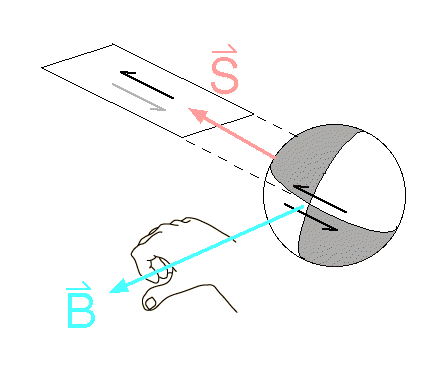
(ii) fault "B-vector" -- unit vector (normalized to length 1.0) pointing
in the plane of the fault and perpendicular to the slip vector. Use
the right-hand-rule as illustrated below to determine which of the two
possible orientations to choose.
(iii) fault slip "S-vector" -- unit vector (normalized to length 1.0) pointing
in the direction of slip on the side chosen to be positive. As implied by the
illustration, positive slip is applied to the side of the fault containing
"S cross B" in the right-hand-rule sense, while slip of the opposite sense
will be applied to the "-S cross B" side of the fault.
(iv) fault dislocation full amplitude -- this is the amount of dislocation
slip applied across the fault. Note: It is NOT the half-amplitude, as was
the case in versions of GeoFEST prior to 4.3!
Also note that whereas earlier versions of GeoFEST terminated the split node list with "0 0", that is no longer the case! The list includes *NO* special terminating string.
example:
(a)         (b)                (c)           (d)
14     0.0  0.0  -1.0     0.0  1.0  0.0      0.4
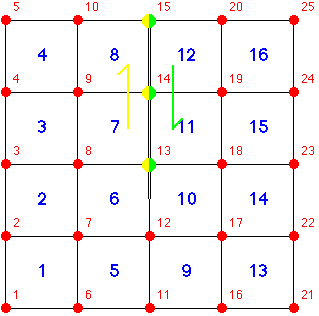
(a) node number -- global node number of this split node.
First figure below illustrates the numbering used for the three
split nodes in this example:
The second figure illustrates the right-hand-rule convention
used for defining the direction of the B-vector for a given
fault orientation and sense of slip: